Little Bee-eater
Merops pusillus - The Little Bee-eater
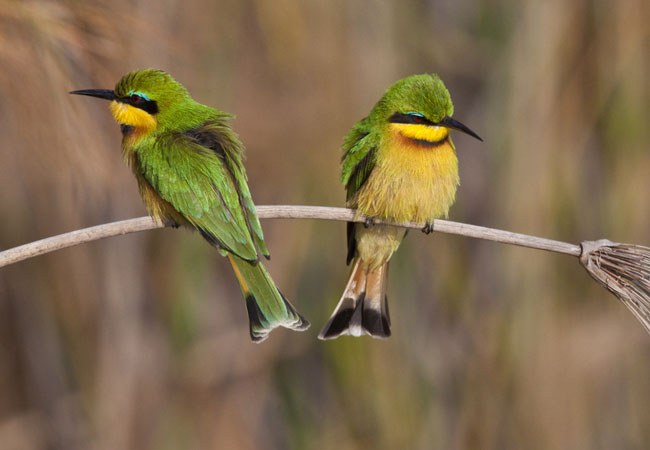
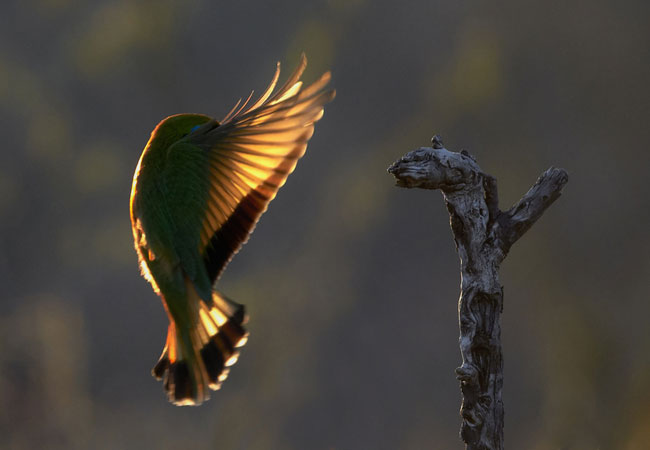
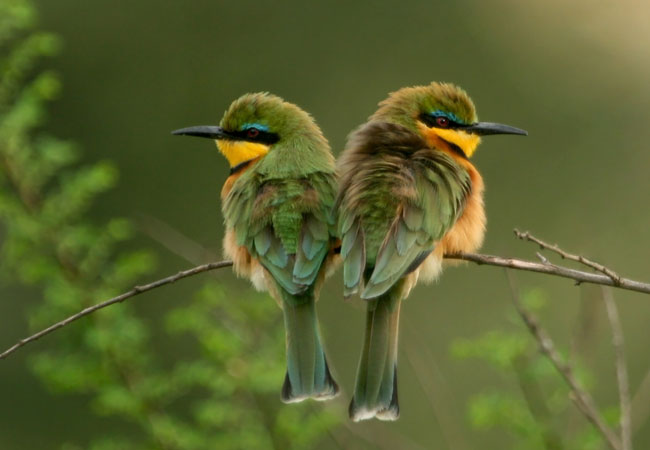
A small, mostly green Bee-eater. As with other Bee-eaters the bill is long, slender and down curved. The bill is black and the feet and legs are dark pinkish. The upperparts are bright green. The underparts and outer flight feathers are a rich orange. The Little Bee-eater has a black collar separating the yellow throat from the orange breast.
Did you know? In Afrikaans the Little Bee-eater is know as 'Kleinbyvreter'.
The centre feathers of the tail are green, and the outer feathers are orange. It has a broad, dark line extending back from the eye, and a turquoise patch just above the eye. Little Bee-eaters are a common species of bushveld, and open woodland, prefers areas with some open ground and reasonably low perches.
Size
Height is about 15 to 17 cm.
Weight is 11 to 18 gms when fully grown.
Habitat
Woodlands, savannah, rivers.
Distribution
Common all over Southern and South Africa. Little Bee-eaters are commonly found in north-eastern South Africa and have taken to residing at golf courses where they nest in holes excavated in the bunkers
Diet
They feed on flying insects especially bees, wasps and hornets. They hawk insects aerially and then return to the perch to beat them to death.
Socialisation
It is usually seen singly or in small parties, in clearings in the bush. It hawks low down in small forays and quite often returns to the same perch, often with their insect prey which they kill by hitting it on a branch. May roost in larger numbers at night, up to 15 birds sleeping huddled in a row. Migration is limited to seasonal movements depending on rainfall patterns. These birds roost communally, lined up on a tree branch.
Reproduction
Little Bee-eaters nest from September to November. The nests are a small burrow usually 50 to 130cm long, excavated in a low bank or Antbear hole. Unlike most bee-eaters, these are solitary nesters. They lay 4 to 6 spherical white eggs. Both the male and the female incubate the eggs for 18 to 20 days.
Incubation
Incubation lasts for 18 to 20 days.
Life Expectancy
12 to 18 years.
Predators
Eagles, Storks, Raptors.
References
Biodiversity Expolerer; Sasol's "Birds of Southern Africa", Fourth Edition.
Additional Reading
You might also be interested inWhere to see Little Bee-eater in their natural habitat?
Want to see little bee-eater in their natural habitat? In South Africa the little Bee-eater can be seen in many gardens, nature parks, botanical gardens and reserves including...
Little Bee-eater
concern
Birdlife
- Birders from around the world come to South Africa to experience the great variety of typically African birds, migrants, endangered, and endemic birds.
- Endemic and Near-Endemic
- Other Notable Species
- African Darter
- African Fish Eagle
- African Hoopoe
- African Jacana
- African Sacred Ibis
- African Scops Owl
- African Spoonbill
- Barn Owl
- Bateleur Eagle
- Bearded Vulture
- Black-headed Heron
- Black-shouldered Kite
- Blue Waxbill
- Common Waxbill
- Crested Barbet
- Egyptian Goose
- Glossy Ibis
- Great White Pelican
- Greater Flamingo
- Grey Crowned Crane
- Grey Heron
- Hadeda Ibis
- Helmeted Guineafowl
- Kori Bustard
- Lappet-faced Vulture
- Lilac Breasted Roller
- Little Bee-eater
- Little Egret
- Malachite Kingfisher
- Marabou Stork
- Martial Eagle
- Ostrich
- Pel's Fishing Owl
- Saddle-billed Stork
- Secretary Bird
- Southern Ground Hornbill
- Spotted Eagle Owl
- Wattled Crane
- Birder-Friendly Lodging
- Game Reserves
Tips & Information for Tourists
- Travelling to South Africa? We make it easy for you to plan your trip online. We have some useful tips for tourists and then start planning your trip with our introduction to South Africa.
- By Province
- Getting to South Africa
- Getting Around in South Africa
- South Africa's Climate
- Exchange Rates and Currency
- Maps / Atlas
- Malaria Risk Areas
- Wildlife
- Birdlife
- Plant Life
- Languages and Culture
- South African Cuisine
- Top Attractions in South Africa
- Popular Tourist Routes
- Find a Hotel
SA-Venues.com® has been assisting travellers with their South Africa travel plans since 1999, and is the largest, independent online travel guide for South Africa available in both English and German.
SA-Venues.com © 1999-2026. All Rights Reserved. Find and book hotels and accommodation in South Africa. Sitemap