Secretary Bird
Sagittarius serpentarius - The Secretary Bird
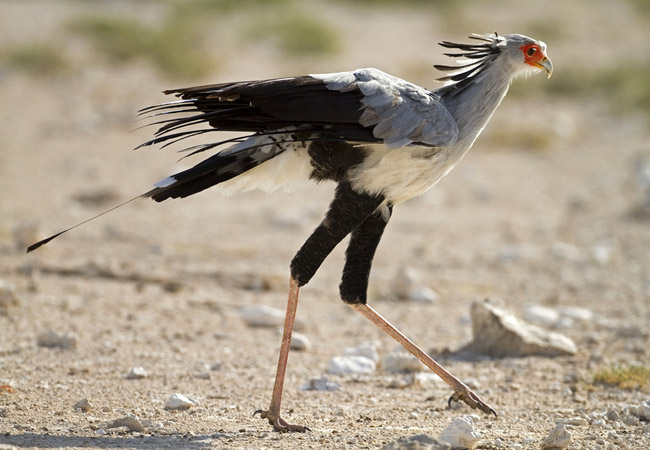
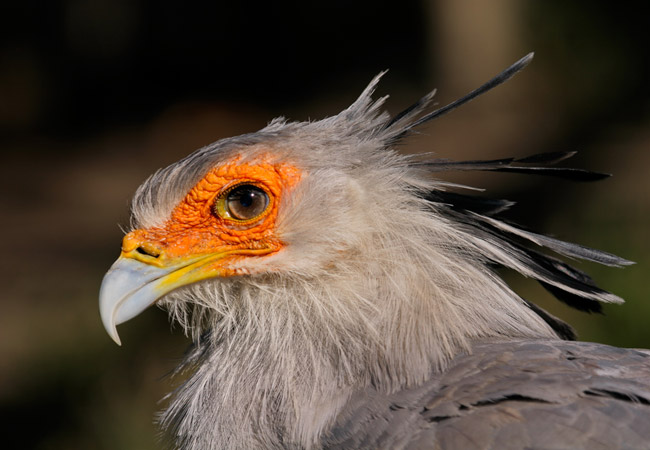
This large bird of prey is named for the crest of long feathers at the back of its head that resemble quill pens that 19th century clerks stuck in their wigs.
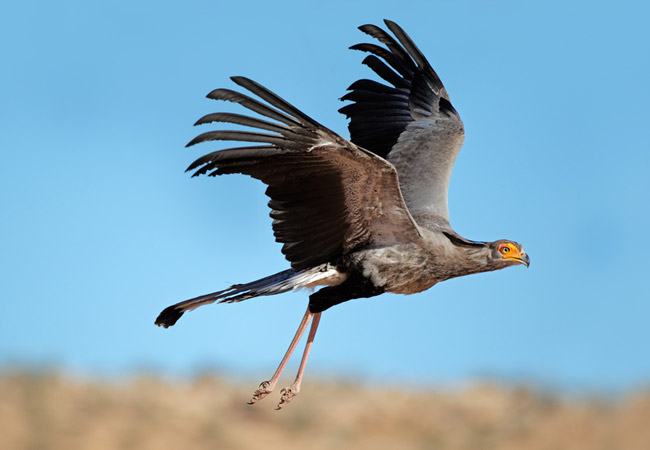
Did you know? Although it can fly, the secretary bird prefers to move around on foot and can cover 30 km a day, earning it the title 'Africa's marching eagle'.
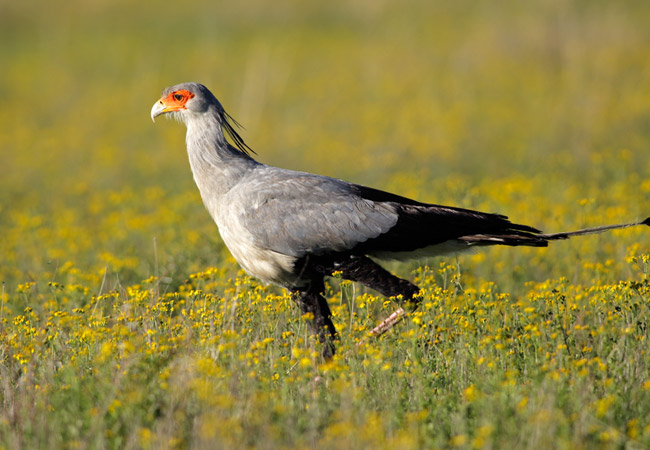
The Secretary bird is an unusual bird. Unlike the other birds of prey, the Secretary Bird has very long legs and tail feathers. Its plumage is light gray, except for the black wing tips, tail, and thighs. Its face is covered in red and yellow skin.
Size
Range mass: 2.3 to 4.6 kg.
Range length: 112 to 152 cm.
Range wingspan: 191 to 220 cm.
Habitat
Although they are usually seen on the ground, Secretary Birds nest in trees (usually acacia). Their nest can reach 8 feet across, even though it only holds 2-3 eggs at time.
Distribution
Secretary birds are found throughout Africa south of the Sahara.
In South Africa, you may spot them at the world-renowned Kruger National Park (between five and six hours' drive from Johannesburg and Pretoria), the Bontebok National Park near Swellendam, and the Sterkfontein Dam Reserve near Harrismith in the Free State.
Diet
The diet of a Secretary bird consists mostly of insects, lizards, snakes, tortoises and rats. Small prey are picked up in the bill and swallowed. Larger prey are first stamped to death and then eaten. The Secretary bird also stamps its feet on the ground to flush out prey. Although they hunt on the ground, the Secretary bird can fly very well, but rarely does so.
Socialisation
The basic social structure in Secretary birds is a life-long pair. However, they are not particularly gregarious. In fact, members of a pair are usually not together, but instead stay a small distance apart.
Communication
Secretary birds are almost completely silent birds, except for a rare croaking sound they utter when displaying.
Reproduction
Primarily incubated by the female, after an incubation period of about 45 days two or three eggs will hatch. Both the parents feed the young. At 60 days, the young start to flap their wings. They stay in the nest for two to three months and can fly after about 80 days.
Incubation
Incubation last for 45 days.
Life Expectancy
10 to 15 years in the wild. They live up to 19 years in captivity.
Predators
Young are preyed upon by crows, ravens, hornbills, large owls and kites. There are no known incidents of predation on the adults.
References
Birdlife International; Arkive.org.
Wish you were here?

Additional Reading
You might also be interested inWhere to see Secretary Bird in their natural habitat?
Want to see secretary bird in their natural habitat? In South Africa, see secretary bird in many reserves and parks including...
Secretary Bird
Birdlife
- Birders from around the world come to South Africa to experience the great variety of typically African birds, migrants, endangered, and endemic birds.
- Endemic and Near-Endemic
- Other Notable Species
- African Darter
- African Fish Eagle
- African Hoopoe
- African Jacana
- African Sacred Ibis
- African Scops Owl
- African Spoonbill
- Barn Owl
- Bateleur Eagle
- Bearded Vulture
- Black-headed Heron
- Black-shouldered Kite
- Blue Waxbill
- Common Waxbill
- Crested Barbet
- Egyptian Goose
- Glossy Ibis
- Great White Pelican
- Greater Flamingo
- Grey Crowned Crane
- Grey Heron
- Hadeda Ibis
- Helmeted Guineafowl
- Kori Bustard
- Lappet-faced Vulture
- Lilac Breasted Roller
- Little Bee-eater
- Little Egret
- Malachite Kingfisher
- Marabou Stork
- Martial Eagle
- Ostrich
- Pel's Fishing Owl
- Saddle-billed Stork
- Secretary Bird
- Southern Ground Hornbill
- Spotted Eagle Owl
- Wattled Crane
- Birder-Friendly Lodging
- Game Reserves
Tips & Information for Tourists
- Travelling to South Africa? We make it easy for you to plan your trip online. We have some useful tips for tourists and then start planning your trip with our introduction to South Africa.
- By Province
- Getting to South Africa
- Getting Around in South Africa
- South Africa's Climate
- Exchange Rates and Currency
- Maps / Atlas
- Malaria Risk Areas
- Wildlife
- Birdlife
- Plant Life
- Languages and Culture
- South African Cuisine
- Top Attractions in South Africa
- Popular Tourist Routes
- Find a Hotel
SA-Venues.com® has been assisting travellers with their South Africa travel plans since 1999, and is the largest, independent online travel guide for South Africa available in both English and German.
SA-Venues.com © 1999-2026. All Rights Reserved. Find and book hotels and accommodation in South Africa. Sitemap