Martial Eagle
Polemaetus Bellicosus - The Martial Eagle
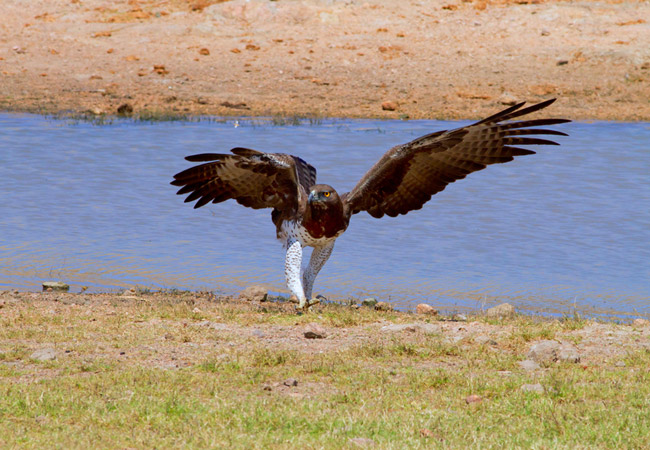
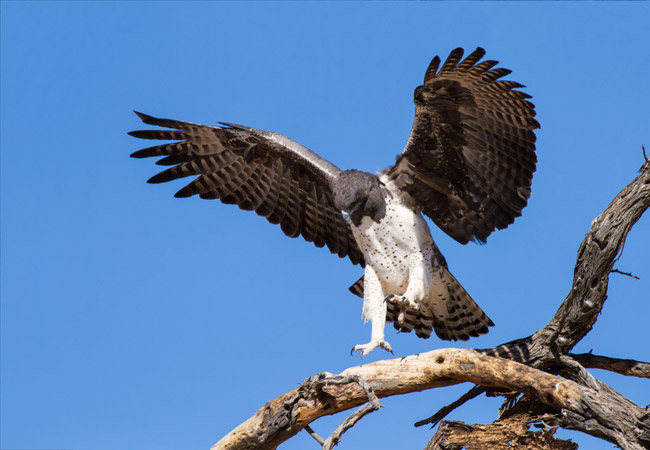
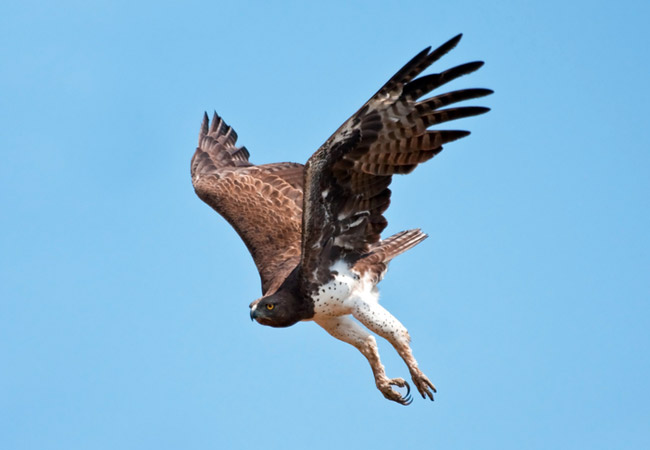
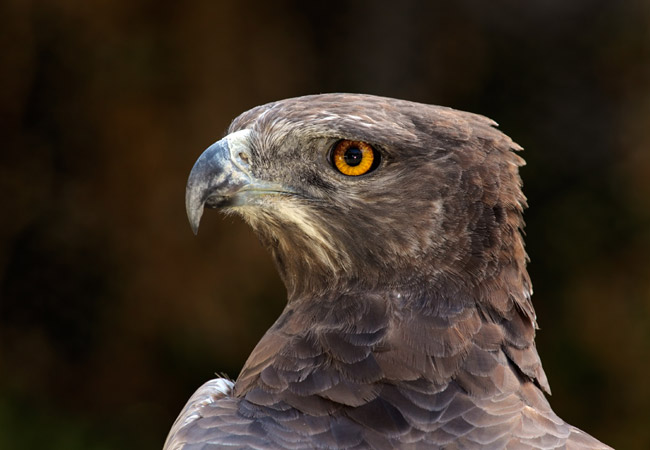
The largest eagle in Africa, the Martial Eagle spends much of its time in flight. Usually seen soaring about hill slopes, often at a very great height making it almost invisible to the naked eye. Martial eagles are known for their superior eyesight (3.0–3.6 times human acuity). They are able to spot potential prey from a very great distance.
Did you know? Martial Eagles require trees for nesting so they are absent from arid or cleared areas - but there have been cases of martial eagles in the Karoo region using power line supports to form nests.
The adult Martial Eagle's plumage has dark brown upperparts, head and upper chest. The underparts of the body are white streaked with black. The underwing coverts are brown, with pale flight feathers, also streaked with black. The female is usually larger and more streaked than the male. The immature bird is paler and has white underparts. It reaches adult plumage in its seventh year.
Nests are built invariably in trees, at any height from 20 to 80 feet above ground, but often in the largest tree in the area, growing on a steep hillside or in a gorge, where the bird has a clear sweep off the nest. Pairs usually have one or two nests, which are used in alternate years if more than one, but for successive breeding attempts if only one. They may be used by a succession of birds for many years.
Size
Range mass: 3 to 6.3 kg.
Range length: 78 to 96 cm.
Range wingspan: 188 to 260 cm.
Habitat
Its preferred habitat is uninhabited stretches of thornbush and savannah, open plains and semi-desert country. It avoids dense forests but requires trees to nest in.
Distribution
Africa south of the Sahara, from Senegal to Somalia and south to Cape Town in the Western Cape. In South Africa, they are more commonly seen in protected areas such as the Kruger National Park (KNP) and Kgalagadi Transfrontier Park amongst many others.
Diet
In some areas birds form an important part of the diet, including guineafowl, francolins, bustards, and poultry. In other areas the diet is largely mammalian, especially hyrax and small antelopes. Animals as large as an Impala calf are taken, and some monkeys, also occasionally young domestic goats, and lambs. Carnivores like mongoose are sometimes taken, even occasionally Serval Cat and Jackal, a few snakes and large lizards. The Martial Eagle will evidently eat whatever is available, with a preference for game-birds, hyrax, and poultry.
Socialisation
Martial Eagles form monogamous pairs and mate for life. They are silent for most of the year, except during the mating season when they will let off a recognisable cry. They spend most of their time on the wing, soaring high above the ground in search of prey.
Reproduction
The breeding season begins in various parts of the range in a wet season, the early dry season, or late in the dry season, and some part of the cycle must extend through rainy periods. Incubation is normally by the female, but a male has been known to sit. The female leaves the nest to feed and is not usually fed by the male at the nest. The incubation period is about 45 days.
The young are very weak and feeble when first hatched, but become more active after about twenty days. At 32 days feathers show through the down, and completely cover the bird at 70 days. The young is fed by its parent until it is about 60 days old, and well feathered, when it starts to tear up its prey itself. The young bird, after making its first flight (at about 100 days), may return to roost in the nest for some days, and thereafter moves away from it. It remains loosely attached to the nest site for some time, and may be seen not far from it for up to six months.
Incubation
Incubation of the eggs lasts for 45 days.
Life Expectancy
14 (average) to 25 (high) years in the wild.
Predators
No known predators although humans may kill Martial Eagle if perceived as pests.
References
ADW; Krugerpark; arkive.org.
Wish you were here?

Additional Reading
You might also be interested inWhere to see Martial Eagle in their natural habitat?
Want to see martial eagle in their natural habitat? In South Africa, see martial eagle in these and many other nature and game reserves and national parks...
Martial Eagle
Birdlife
- Birders from around the world come to South Africa to experience the great variety of typically African birds, migrants, endangered, and endemic birds.
- Endemic and Near-Endemic
- Other Notable Species
- African Darter
- African Fish Eagle
- African Hoopoe
- African Jacana
- African Sacred Ibis
- African Scops Owl
- African Spoonbill
- Barn Owl
- Bateleur Eagle
- Bearded Vulture
- Black-headed Heron
- Black-shouldered Kite
- Blue Waxbill
- Common Waxbill
- Crested Barbet
- Egyptian Goose
- Glossy Ibis
- Great White Pelican
- Greater Flamingo
- Grey Crowned Crane
- Grey Heron
- Hadeda Ibis
- Helmeted Guineafowl
- Kori Bustard
- Lappet-faced Vulture
- Lilac Breasted Roller
- Little Bee-eater
- Little Egret
- Malachite Kingfisher
- Marabou Stork
- Martial Eagle
- Ostrich
- Pel's Fishing Owl
- Saddle-billed Stork
- Secretary Bird
- Southern Ground Hornbill
- Spotted Eagle Owl
- Wattled Crane
- Birder-Friendly Lodging
- Game Reserves
Tips & Information for Tourists
- Travelling to South Africa? We make it easy for you to plan your trip online. We have some useful tips for tourists and then start planning your trip with our introduction to South Africa.
- By Province
- Getting to South Africa
- Getting Around in South Africa
- South Africa's Climate
- Exchange Rates and Currency
- Maps / Atlas
- Malaria Risk Areas
- Wildlife
- Birdlife
- Plant Life
- Languages and Culture
- South African Cuisine
- Top Attractions in South Africa
- Popular Tourist Routes
- Find a Hotel
SA-Venues.com® has been assisting travellers with their South Africa travel plans since 1999, and is the largest, independent online travel guide for South Africa available in both English and German.
SA-Venues.com © 1999-2026. All Rights Reserved. Find and book hotels and accommodation in South Africa. Sitemap