Marabou Stork
Leptoptilos crumeniferus - The Marabou Stork
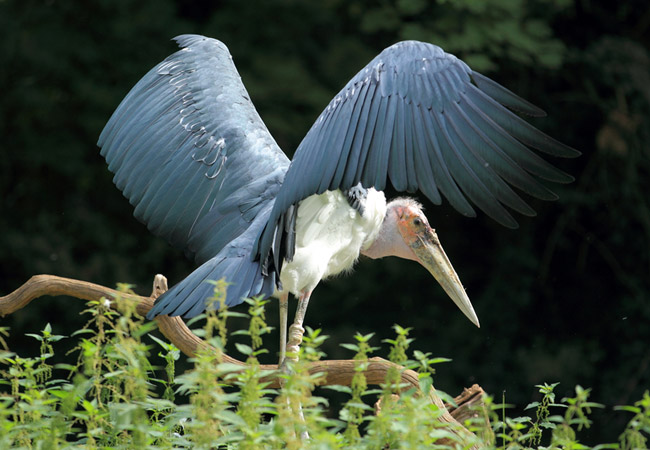
This is a huge, unmissable and unmistakable stork. Marabou are scavengers and can be found around refuse dumps as well as with vultures around carcasses. Marabou Stork don't rely solely on scavenging, they will catch small rodents and reptiles.
Did you know? Marabou Stork are known as "The Undertaker" bird due to its rather strange appearance.
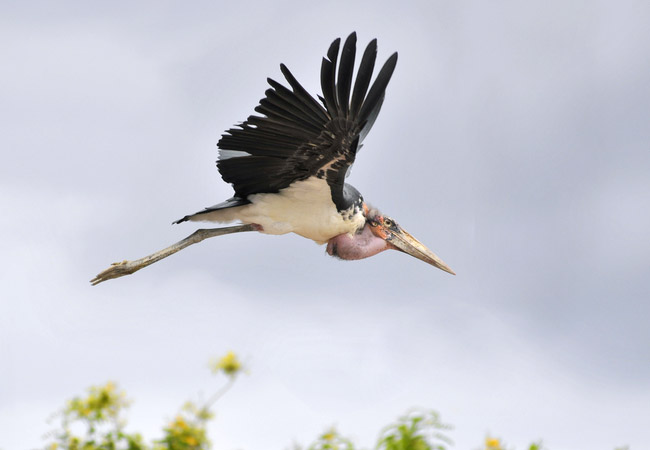
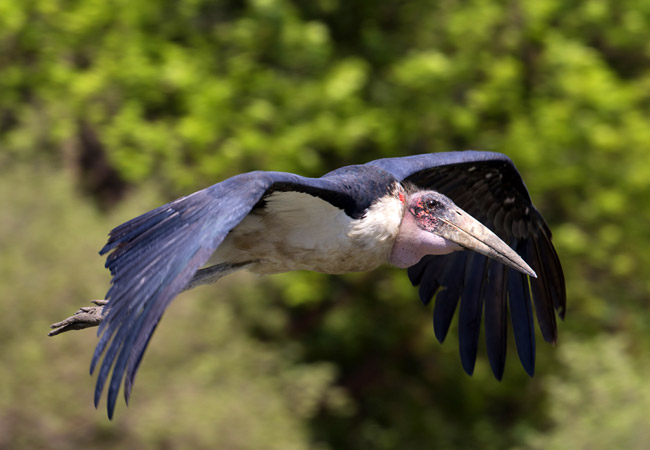
Airborne, the Marabou are superb flyers, soaring at high altitude across the plains.
A large male Marabou Stork, standing up to 1.5 m tall and weighing nearly 9 kg, is one of the largest flying birds in the world. Their wingspan approaches 2.9 m.
Size
Weight: 9 kg.
Height: 1.5 m.
Wingspan: 2.9 m.
Habitat
Marabou prefer dry open savannahs near large lakes or rivers. Marabous are often found around fishing villages, slaughterhouses, and rubbish dumps.
Distribution
The Marabou Stork is found throughout most of tropical Africa.
In South Africa, see them at Ben Lavin Nature Reserve near Louis Trichardt, African Bird of Prey Sanctuary in the Valley of 1 000 Hills, Lake Mavuya and the iSimangaliso Wetland Park, both in St Lucia in KwaZulu Natal.
Diet
Marabou Storks behave more like vultures than stork and will eat just about any kind of animal, dead or alive.
Living prey includes termites, fish, locusts, grasshoppers, army-worm caterpillars, frogs, rodents, crocodile eggs and hatchlings, quelea nestlings, doves, young and adult flamingos, cormorant nestlings, and pelican chicks.
Socialisation
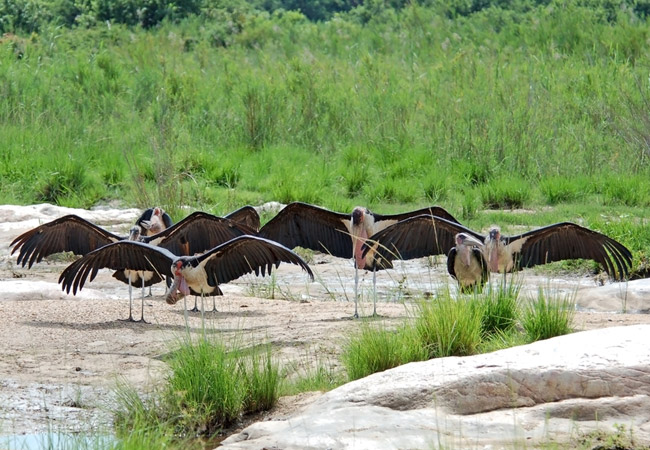
A gregarious bird, the marabou stork is often seen in groups, with up to 1,000 individuals gathering in close proximity to roost at night.
A colonial breeder, with colonies ranging in size from 20 pairs up to several thousand and often living alongside other species. They are rather lazy birds and spend much of their time standing around, motionless.
Reproduction
The female lays 2-3 chalky white eggs.
Both parents incubate for 29-31 days.
Chicks grow rapidly in the first few weeks of life as their parents keep them constantly supplied with food regurgitated onto the floor of the nest.
The pre-fledging period, 95-115 days, is relatively long in this species.
Most birds reach sexual maturity in their fourth year and may live for more than 25 years.
Incubation
The incubation period lasts for 29 to 31 days.
Life Expectancy
Up to 25 years.
Predators
Humans.
References
Arkive.org; Birdlife International.
Wish you were here?

Additional Reading
You might also be interested inWhere to see Marabou Stork in their natural habitat?
Want to see marabou stork in their natural habitat? In South Africa, see marabou stork in these and other game and wildlife reserves and national parks including...
Marabou Stork
concern
Birdlife
- Birders from around the world come to South Africa to experience the great variety of typically African birds, migrants, endangered, and endemic birds.
- Endemic and Near-Endemic
- Other Notable Species
- African Darter
- African Fish Eagle
- African Hoopoe
- African Jacana
- African Sacred Ibis
- African Scops Owl
- African Spoonbill
- Barn Owl
- Bateleur Eagle
- Bearded Vulture
- Black-headed Heron
- Black-shouldered Kite
- Blue Waxbill
- Common Waxbill
- Crested Barbet
- Egyptian Goose
- Glossy Ibis
- Great White Pelican
- Greater Flamingo
- Grey Crowned Crane
- Grey Heron
- Hadeda Ibis
- Helmeted Guineafowl
- Kori Bustard
- Lappet-faced Vulture
- Lilac Breasted Roller
- Little Bee-eater
- Little Egret
- Malachite Kingfisher
- Marabou Stork
- Martial Eagle
- Ostrich
- Pel's Fishing Owl
- Saddle-billed Stork
- Secretary Bird
- Southern Ground Hornbill
- Spotted Eagle Owl
- Wattled Crane
- Birder-Friendly Lodging
- Game Reserves
Tips & Information for Tourists
- Travelling to South Africa? We make it easy for you to plan your trip online. We have some useful tips for tourists and then start planning your trip with our introduction to South Africa.
- By Province
- Getting to South Africa
- Getting Around in South Africa
- South Africa's Climate
- Exchange Rates and Currency
- Maps / Atlas
- Malaria Risk Areas
- Wildlife
- Birdlife
- Plant Life
- Languages and Culture
- South African Cuisine
- Top Attractions in South Africa
- Popular Tourist Routes
- Find a Hotel
SA-Venues.com® has been assisting travellers with their South Africa travel plans since 1999, and is the largest, independent online travel guide for South Africa available in both English and German.
SA-Venues.com © 1999-2026. All Rights Reserved. Find and book hotels and accommodation in South Africa. Sitemap