Cape Gannet
Morus capensis - The Cape Gannet
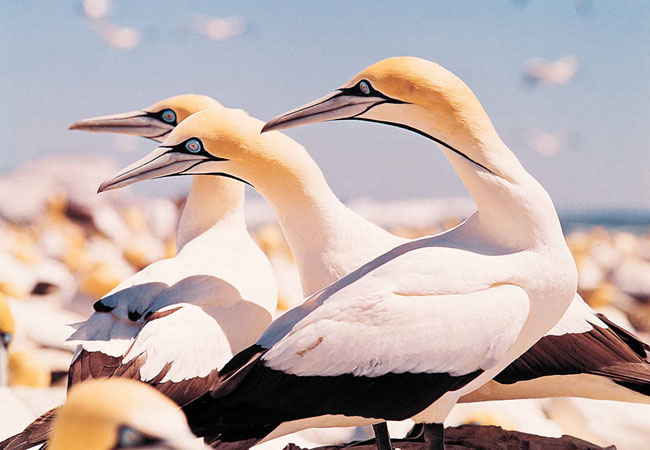
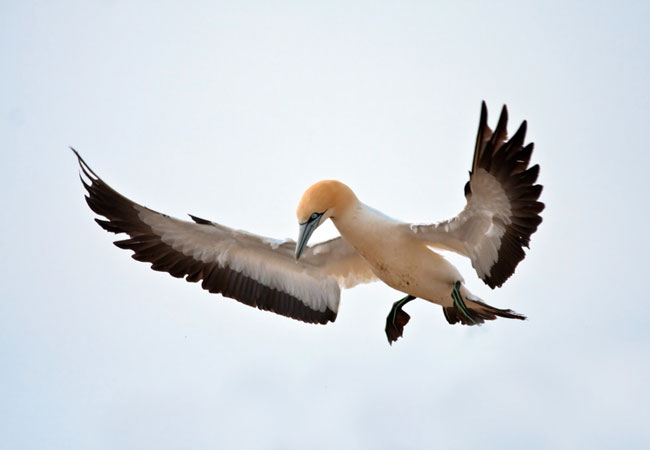
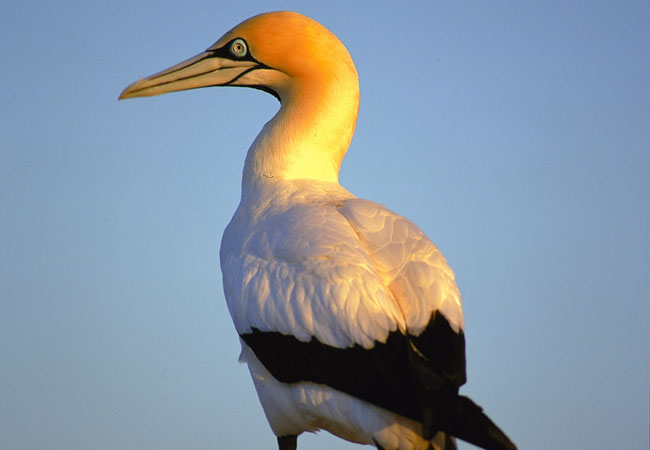
Cape Gannets are easily recognised for their eye-catching black and white plumage which appears silky, giving them a graceful, swan-like appearance. They have distinguishing black lines around the beak and on the face (which almost look as if they have been applied by a skilled make-up artist). The long, pale blue bill is pointed with serrations close to the tip and the feet are large and webbed between each toe.
Did you know? From a height of 30 metres, Cape Gannets dive 10 metres under water on a mission to catch their piece of the seafood buffet.
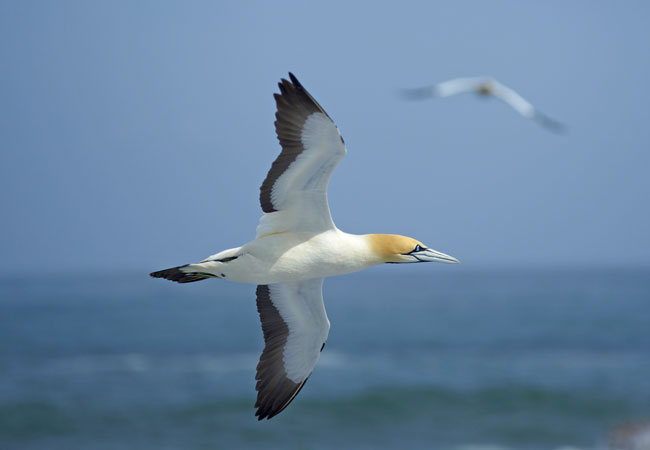
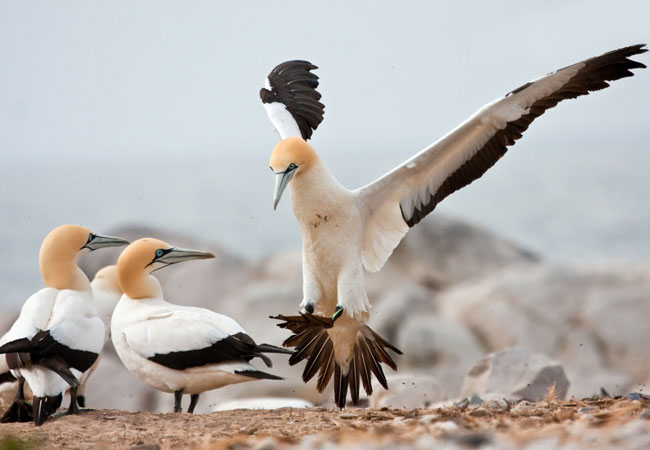
When seen in flight the snow-white body with the black tail, primaries and secondaries, and bill are most striking. The golden crown and nape which gradually become white on the neck are characteristic of this beautiful bird. Impressively graceful in flight, Cape Gannets have a clumsy gait on land.
Size
Range mass: 2 - 2.6 kg.
Range length: 84 - 95 cm.
Range wingspan: 170 - 185 cm.
Habitat
Within its normal range, Cape Gannets are restricted to the continental shelf, at no more than 100 km from the coast. Occasionally they have been recorded on oceanic waters.
Distribution
Cape Gannets are restricted to the coast of Africa. They are found in waters off the Western Sahara, around Cape Agulhas and the Cape West Coast to the Gulf of Zanzibar (Tanzania) and occasionally to Mombasa (Kenya) on the east coast of Africa.
They can also be found at the Bird Island Nature Reserve and Verlorenvlei, both connected to Lambert's Bay, the St Croix Island Marine Reserve (just off the coast of Port Elizabeth), the West Coast National Park and the Grotto Bay Coastal Nature Reserve (both less than an hour from Cape Town).
Breeding is restricted to just six small islands, making the Cape gannet vulnerable. This is due to the over-exploitation of its prey by human fisheries, pollution, and human disturbance. In South Africa, the colonies can be found in Lambert's Bay and Bird Island (under the administration of CapeNature Conservation) and Malgas Island (under the administration of South African National Parks).
Diet
Cape Gannets feed on shoaling pelagic fish such as sardines and pilchards, eating up to 300g daily.
Socialisation
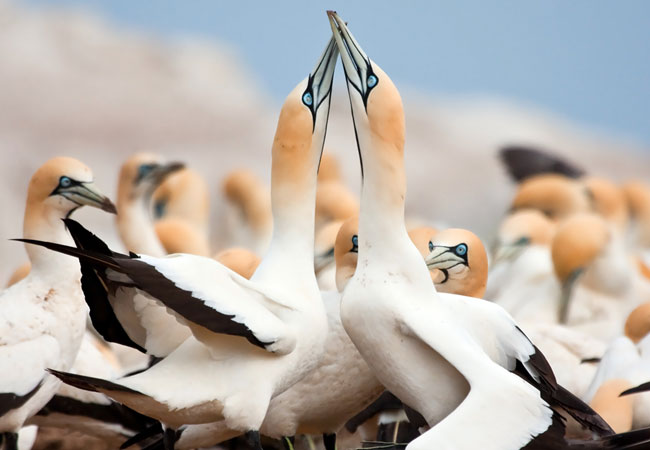
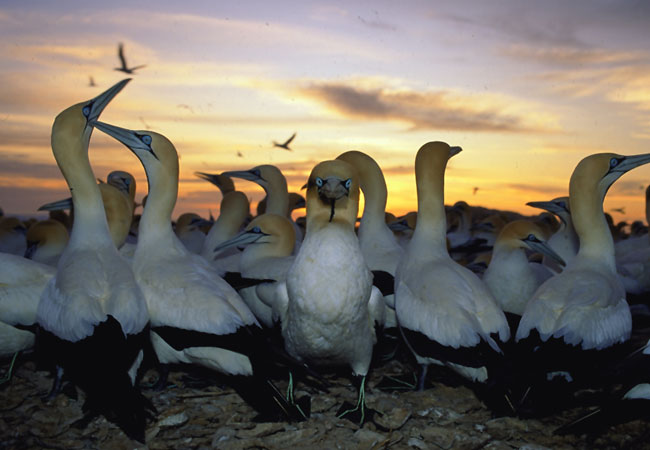
Cape Gannets are social birds. Gannets pairs may remain together over several seasons. They perform elaborate greeting rituals at the nest, stretching their bills and necks skywards and gently tapping bills together (see photograpgs above). Cape Gannets are not strictly migratory and the majority of birds remain within 500km of their breeding site, all year round.
Reproduction
The breeding season begins in August when the pairs form and nests are rebuilt. Nest mounds are built on guano and are unlined. A single blue egg is laid and quickly becomes coated in brown guano. Most eggs are laid in October. The eggs are incubated for approximately 40 days. Both adults incubate the eggs using the webs of their feet. Both parents care for the chick for 97 days before it goes to sea.
Incubation
40 days.
Life Expectancy
Estimated at 10 to 20 years.
Predators
Great white pelicans and humans.
References
Birdlife International; Animal Diversity Web.
Wish you were here?

Additional Reading
You might also be interested inWhere to see Cape Gannet in their natural habitat?
Want to see cape gannets in their natural habitat? In South Africa, the cape gannet can be seen in these reserves...
Cape Gannet
Birdlife
- Birders from around the world come to South Africa to experience the great variety of typically African birds, migrants, endangered, and endemic birds.
- Endemic and Near-Endemic
- Other Notable Species
- African Darter
- African Fish Eagle
- African Hoopoe
- African Jacana
- African Sacred Ibis
- African Scops Owl
- African Spoonbill
- Barn Owl
- Bateleur Eagle
- Bearded Vulture
- Black-headed Heron
- Black-shouldered Kite
- Blue Waxbill
- Common Waxbill
- Crested Barbet
- Egyptian Goose
- Glossy Ibis
- Great White Pelican
- Greater Flamingo
- Grey Crowned Crane
- Grey Heron
- Hadeda Ibis
- Helmeted Guineafowl
- Kori Bustard
- Lappet-faced Vulture
- Lilac Breasted Roller
- Little Bee-eater
- Little Egret
- Malachite Kingfisher
- Marabou Stork
- Martial Eagle
- Ostrich
- Pel's Fishing Owl
- Saddle-billed Stork
- Secretary Bird
- Southern Ground Hornbill
- Spotted Eagle Owl
- Wattled Crane
- Birder-Friendly Lodging
- Game Reserves
Tips & Information for Tourists
- Travelling to South Africa? We make it easy for you to plan your trip online. We have some useful tips for tourists and then start planning your trip with our introduction to South Africa.
- By Province
- Getting to South Africa
- Getting Around in South Africa
- South Africa's Climate
- Exchange Rates and Currency
- Maps / Atlas
- Malaria Risk Areas
- Wildlife
- Birdlife
- Plant Life
- Languages and Culture
- South African Cuisine
- Top Attractions in South Africa
- Popular Tourist Routes
- Find a Hotel
SA-Venues.com® has been assisting travellers with their South Africa travel plans since 1999, and is the largest, independent online travel guide for South Africa available in both English and German.
SA-Venues.com © 1999-2026. All Rights Reserved. Find and book hotels and accommodation in South Africa. Sitemap