African Spoonbill
Platalea alba - The African Spoonbill
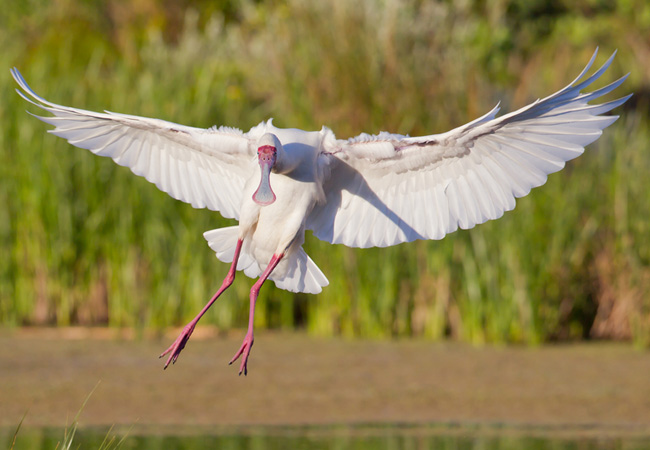
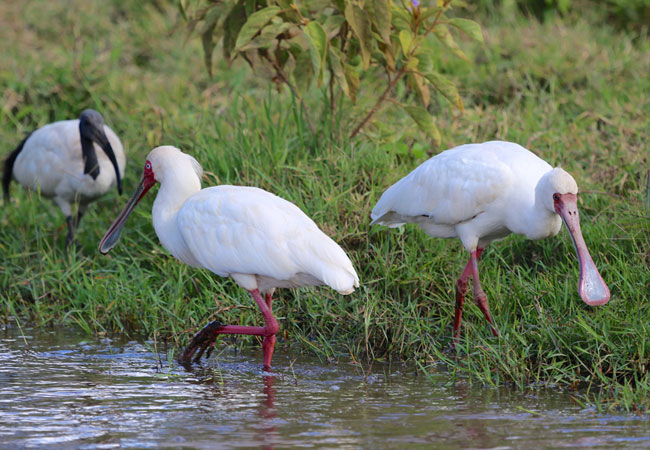
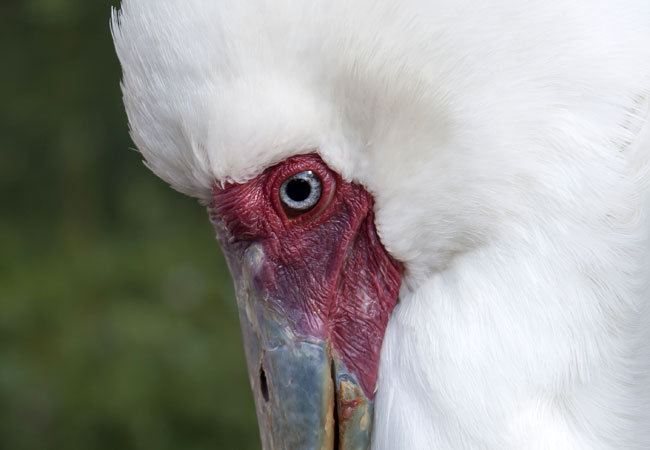
The African Spoonbill is a long legged wading bird. Its body is mostly white, except for its legs, face and uniquely spoon-shaped bill which are red. The male and female of this species are alike in appearance. They are born with short beaks that gradually develop into the characteristic spoon-like shapes bills they are named after.
Did you know? Young birds are born without the 'spoon' and more closely resemble ibises until their bill grows.
The African Spoonbill is a shy and alert bird, usually silent, barring a loud grunt when startled or alerted to danger. This bird travels by flight extending its neck and legs while flapping its wings steadily in the air.
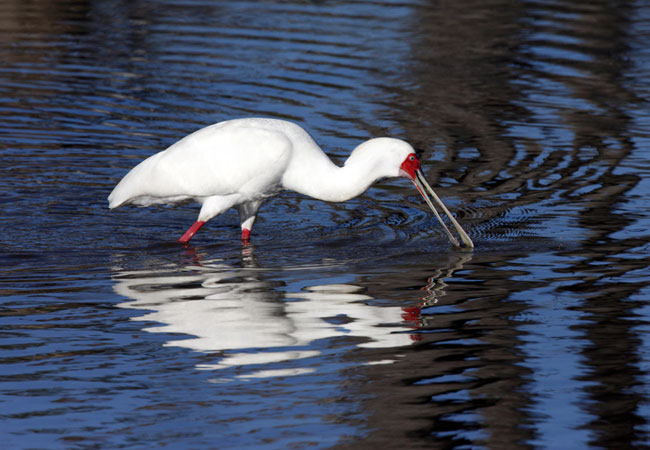
The Spoonbill feeds by fishing in shallow water by swinging its open bill from side to side, which acts as a hooked tool to seize or clutch its food.
Size
Height: 90 cm.
Wingspan: 120 to 135 cm.
Habitat
The African Spoonbill usually resides by shallow inland waters. Habitat includes river banks, lake shores, marshes, plains, savannas and swamps.
Distribution
The African Spoonbill is found in several countries in the southern part of Africa including Botswana, Kenya, Madagascar, Mozambique, Namibia and South Africa.
In South Africa, they can be spotted at the Marievale Bird Sanctuary (less than an hour from Johannesburg and about 80 minutes from Pretoria), Bartholomeus Klip Renosterveld Reserve outside Cape Town, and the False Bay Ecology Park in the Cape Flats.
Diet
They feed on fish and aquatic invertebrates such as crustaceans or shellfish, insects, larvae, and molluscs.
Socialisation
The African Spoonbill is a shy and alert bird, usually found singly, but can also be encountered in pairs or in groups. They are monogamous birds although the male may attempt to mate with more than one partner during the breeding season.
Communication
African Spoonbill is a silent bird except when it is alarmed at which time it lets out a distinctive groan.
Reproduction
The African Spoonbill usually breeds in communities from the end of March through to September. The female lays three to five eggs during the months of April and May.
The eggs are laid in nests fashioned out of sticks and reeds in a tree, always near water, but nests are also established amongst swamp reeds and marsh plants, rocks and cliffs. The inside of the nest is usually lined with plant matter and leaves.
The egg is incubated for up to 29 days by both parents. Once hatched, both parents care for the chicks for up to thirty days after which the young birds are ready to leave the nest. Four weeks later they are able to fly.
Incubation
3 to 5 eggs are incubated for 29 days.
Life Expectancy
15 years in the wild, 17 years in captivity.
Predators
Chicks and eggs are predated by House Crow.
References
Birdlife Int.; Biodiversity Explorer
Wish you were here?

Additional Reading
You might also be interested inWhere to see African Spoonbill in their natural habitat?
Want to see african spoonbill in their natural habitat? In South Africa, the african spoonbill can be seen in these reserves and parks...
African Spoonbill
concern
Birdlife
- Birders from around the world come to South Africa to experience the great variety of typically African birds, migrants, endangered, and endemic birds.
- Endemic and Near-Endemic
- Other Notable Species
- African Darter
- African Fish Eagle
- African Hoopoe
- African Jacana
- African Sacred Ibis
- African Scops Owl
- African Spoonbill
- Barn Owl
- Bateleur Eagle
- Bearded Vulture
- Black-headed Heron
- Black-shouldered Kite
- Blue Waxbill
- Common Waxbill
- Crested Barbet
- Egyptian Goose
- Glossy Ibis
- Great White Pelican
- Greater Flamingo
- Grey Crowned Crane
- Grey Heron
- Hadeda Ibis
- Helmeted Guineafowl
- Kori Bustard
- Lappet-faced Vulture
- Lilac Breasted Roller
- Little Bee-eater
- Little Egret
- Malachite Kingfisher
- Marabou Stork
- Martial Eagle
- Ostrich
- Pel's Fishing Owl
- Saddle-billed Stork
- Secretary Bird
- Southern Ground Hornbill
- Spotted Eagle Owl
- Wattled Crane
- Birder-Friendly Lodging
- Game Reserves
Tips & Information for Tourists
- Travelling to South Africa? We make it easy for you to plan your trip online. We have some useful tips for tourists and then start planning your trip with our introduction to South Africa.
- By Province
- Getting to South Africa
- Getting Around in South Africa
- South Africa's Climate
- Exchange Rates and Currency
- Maps / Atlas
- Malaria Risk Areas
- Wildlife
- Birdlife
- Plant Life
- Languages and Culture
- South African Cuisine
- Top Attractions in South Africa
- Popular Tourist Routes
- Find a Hotel
SA-Venues.com® has been assisting travellers with their South Africa travel plans since 1999, and is the largest, independent online travel guide for South Africa available in both English and German.
SA-Venues.com © 1999-2026. All Rights Reserved. Find and book hotels and accommodation in South Africa. Sitemap