African Jacana

Actophilornis africana - The African Jacana
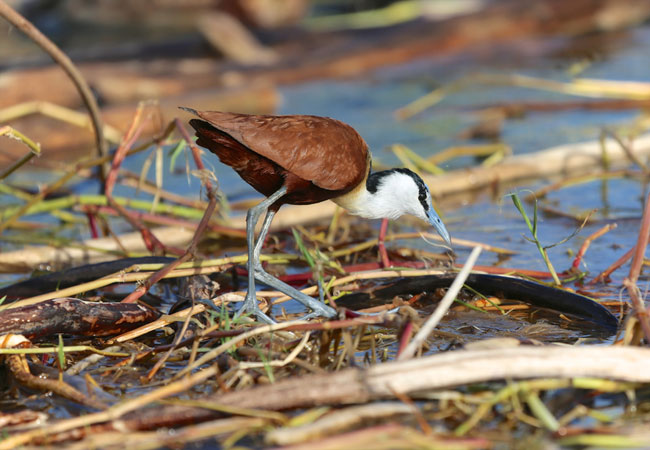
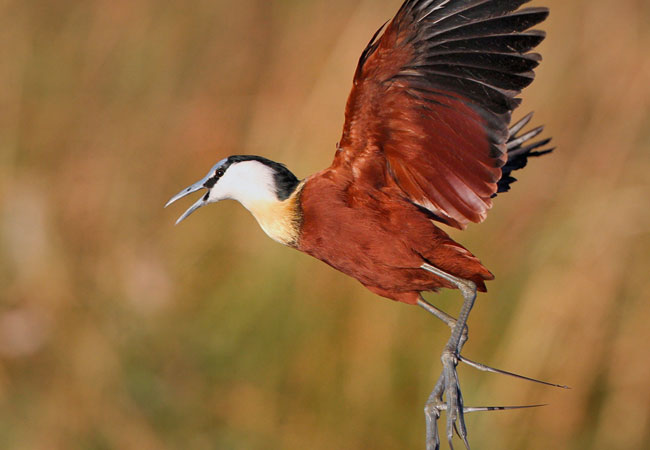
These graceful birds are good divers and strong flyers. Squawking during flight, the African Jacana has a keen sense of sight and hearing and relies little on its sense of smell. The female bird is larger than the male although the colouring of the feathers are much the same between the sexes. Their impressive markings include chestnut brown feathers at their wings, and yellow-orange breast feathers.
Did you know? In Afrikaans, the graceful African Jacana is known as 'Grootlangtoon' and its Zulu name is 'iThandaluzibo'.
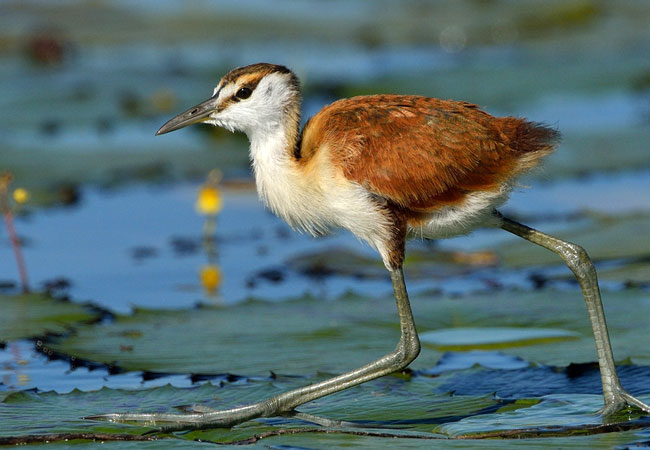
The front of the neck is white and the back of the neck and head are glossy black in colour. The African Jacana's characteristic bill is bluish-gray and the eyes are dark brown. The legs and toes are rather long in relation to the rest of the bird's body size.
These lovely birds are known as 'lily walkers' because their slender legs and toes give them the gracefulness to walk on the lily pads that blanket their wetlands. Due to their smaller size, the males are a lot more graceful than the females of the species.
Quick Facts
Size
Range mass: 1.4 to 2.6 kg.
Range length: 23 to 31 cm.
Habitat
African Jacana prefer lagoons, swamps and marshes, where there are lily pads and other floating vegetation. It spends most of its life on large floating leaves. Non-migratory, they are however highly nomadic, often moving in search of new temporary wetlands.
Distribution
They are found throughout Zimbabwe, Mozambique, northern Namibia, northern Botswana. In South Africa, African Jacana are abundant in the eastern parts and less common in the rest of the country. To see them, visit the Kruger National Park, the Umhlanga Ponds reserve in Umhlanga and the Bluff Nature Reserve (both around Durban), and several spots within the iSimangaliso Wetland Park in St Lucia including Lake Sibaya.
Diet
Their diet consists primarily of insects (beetles, flies etc.) but also consume small crabs, snails, and small fish.
Socialisation
African Jacanas are sociable birds gathering together in groups near their preferred swamp-like habitats. Confrontational behaviour among same-sexed birds begins at the end of winter and escalates before the mating season which occurs from November to March. African Jacanas are not monogamous in their mating patterns, the female choosing more than one mate each season.
A mating pair can have up to 30 clutches of eggs each season, resulting from either the same partner or various partners. The female African Jacana is more dominant than the male and much larger. At times she will be highly selective about whom she chooses to mate with and she rarely chooses the same partner for every clutch of eggs that she lays.
Communication
These colourful waterbirds send out loud, raucous calls when danger lurks or intruders fly over their territory. It is a noisy bird letting out a range of calls and sounds.
Reproduction
The nest is usually a simple, partly submerged pad of aquatic vegetation, although on deeper water, nests are generally placed on small floating 'rafts' of vegetation. The female African Jacana lays several clutches of eggs between December and April. The eggs are brown in colour, glossy, with irregular black markings.
The male African Jacana is the primary caretaker of the offspring, incubating the eggs and carrying the baby chicks under his wings to keep them warm and dry until the chicks are approximately 18 days old.
Incubation
Incubation lasts about 23 to 27 days and the young fledge after 50 days
Life Expectancy
Information required.
Predators
Predators of the African Jacana's eggs and chicks are the nile monitor, cape clawless otter and hippopotamus. Their eggs and young chicks are often preyed upon so the survival of the species is dependent on the mother's ability to lay several clutches of eggs in one season.
References
Birdlife International; Biodiversity Explorer.
Wish you were here?

Additional Reading
You might also be interested inWhere to see African Jacana in their natural habitat?
Want to see african jacana in their natural habitat? In South Africa, the african jacana can be seen in these reserves and parks...
African Jacana
concern
Birdlife
- Birders from around the world come to South Africa to experience the great variety of typically African birds, migrants, endangered, and endemic birds.
- Endemic and Near-Endemic
- Other Notable Species
- African Darter
- African Fish Eagle
- African Hoopoe
- African Jacana
- African Sacred Ibis
- African Scops Owl
- African Spoonbill
- Barn Owl
- Bateleur Eagle
- Bearded Vulture
- Black-headed Heron
- Black-shouldered Kite
- Blue Waxbill
- Common Waxbill
- Crested Barbet
- Egyptian Goose
- Glossy Ibis
- Great White Pelican
- Greater Flamingo
- Grey Crowned Crane
- Grey Heron
- Hadeda Ibis
- Helmeted Guineafowl
- Kori Bustard
- Lappet-faced Vulture
- Lilac Breasted Roller
- Little Bee-eater
- Little Egret
- Malachite Kingfisher
- Marabou Stork
- Martial Eagle
- Ostrich
- Pel's Fishing Owl
- Saddle-billed Stork
- Secretary Bird
- Southern Ground Hornbill
- Spotted Eagle Owl
- Wattled Crane
- Birder-Friendly Lodging
- Game Reserves
Tips & Information for Tourists
- Travelling to South Africa? We make it easy for you to plan your trip online. We have some useful tips for tourists and then start planning your trip with our introduction to South Africa.
- By Province
- Getting to South Africa
- Getting Around in South Africa
- South Africa's Climate
- Exchange Rates and Currency
- Maps / Atlas
- Malaria Risk Areas
- Wildlife
- Birdlife
- Plant Life
- Languages and Culture
- South African Cuisine
- Top Attractions in South Africa
- Popular Tourist Routes
- Find a Hotel
SA-Venues.com® has been assisting travellers with their South Africa travel plans since 1999, and is the largest, independent online travel guide for South Africa available in both English and German.
SA-Venues.com © 1999-2026. All Rights Reserved. Find and book hotels and accommodation in South Africa. Sitemap