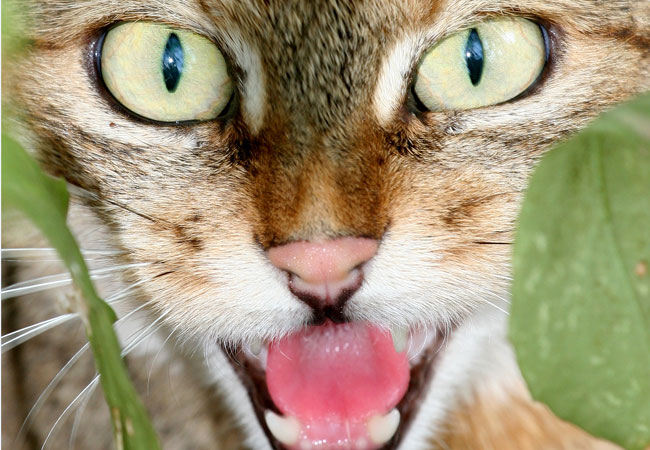

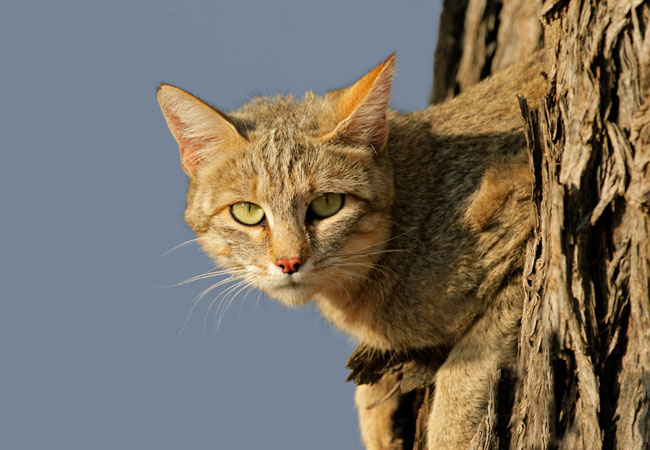
Felis libyca - The African Wild Cat
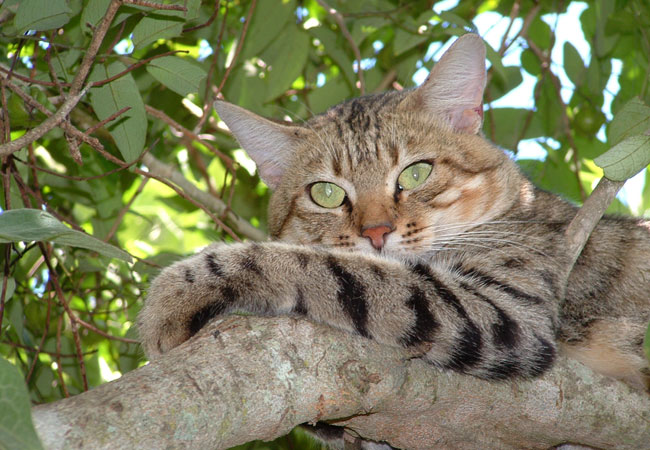
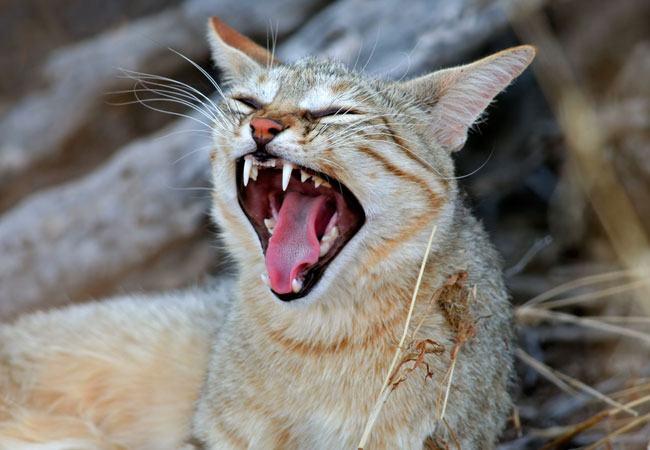
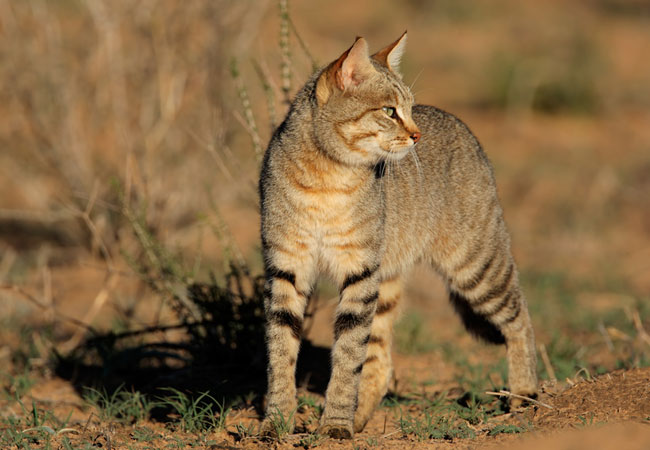
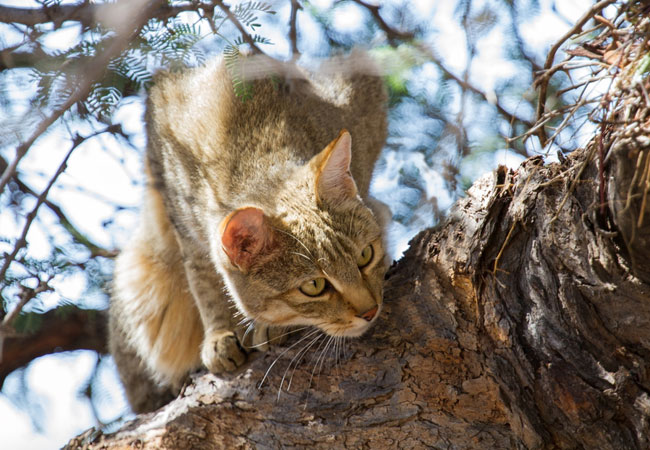
The African wild cat is sandy brown to yellow grey in colour, with black stripes on the tail. The fur is shorter than that of the European subspecies and it is also considerably smaller.
Today's domestic cats are generally believed to be descendants of the African Wild Cat, which were tamed by the Egyptians over 4000 years ago to control rats and mice raiding their granaries.
Did you know? A major threat to the existence of this species is crossbreeding with domestic cats, especially in rural areas that lie adjacent to game reserves.
Apart from the obvious difference in their ear coloration and the longer legs, the African Wild Cat is easily mistaken for a domestic cat. Interbreeding is possible as they are so closely related to domestic cats. Pure genetic African Wild Cats are quite rare and only found in remote areas as elsewhere interbreeding with domestic cats has taken place.
Size
Slightly larger than a domestic cat.
Head to body length: 45 to 75 cm; Tail: 20 to 38 cm
Weight
3 to 6.5 kg
Habitat
Steppes, savannahs and bushland.
Distribution
It is rare to see the African wild cat these days, as so much interbreeding has occurred with domestic cats. So, visit one of the few reserves that are still home to them. These include the Cederberg Wilderness Area and the Groot Winterhoek Wilderness Area, both a few hours' drive from Cape Town, the Mount Sheba Nature Reserve (an hour from Sabie in Mpumalanga), the Soetdoring Dam Nature Reserve in the Free State, and the Hoedspruit Endangered Species Centre in Limpopo.
Diet - Carnivore
African Wild Cats eat primarily mice, rats and other small mammals. They also eat birds, reptiles, amphibians and insects if available.
Socialisation
The African Wild Cat is generally solitary except when mating, or when the female is raising kittens. Both males and females establish territories which they mark and defend.
The territory of a male overlaps with that of a few females, who defend the territory against intruders. African wild cats are nocturnal in the warm weather and diurnal (mainly active during the night and twilight) during very cold weather.
Reproduction
A female gives birth to an average of 3 kittens. Mating occurs between July and January and young are born between September to March. Kittens are born blind and need full care of the mother. Most kittens are born in the wet season, when there is sufficient food. They stay with their mother for five to six months, and are fertile after one year.
Gestation
Gestation is approximately 65 days.
Life Expectancy
12 to 15 years.
Predators
Wild cats are preyed upon as young cats by larger predators, such as foxes, wolves, other cats, and large birds of prey, such as owls, eagles and hawks. African Wild cats are fierce when threatened and can protect themselves from animals larger than themselves.
Wish you were here?

Additional Reading
You might also be interested inWhere to see African Wild Cat in their natural habitat?